Choosing a Fully Automatic Coil Winding Machine in 2026 requires more than comparing speed and price. The right decision connects production targets, coil geometry, wire handling, quality control, and long-term service support. A machine may advertise 12,000 revolutions per minute, yet fail when winding fine enamelled wire around narrow bobbins. That gap matters.
Industry demand is becoming more complex. The International Energy Agency reported in its Global EV Outlook 2025 that electric car sales exceeded 17 million units worldwide in 2024. Electric vehicles require motors, inductors, transformers, and other wound components. The U.S. Department of Energy also continues to emphasize motor efficiency and advanced manufacturing in its energy technology research. These trends increase pressure on manufacturers to achieve stable tension, accurate turns, low scrap, and repeatable electrical performance.
Not every factory needs the fastest machine.
A practical evaluation should begin with the product itself. Check wire diameter, insulation type, bobbin size, winding pattern, permissible tension range, and required turns per coil. Then examine automatic loading, wire break detection, visual inspection, recipe management, and data traceability. Reports from the International Organization for Standardization, including ISO 9001 guidance, reinforce the value of controlled processes and documented quality records. In real production, a two-second changeover saving can matter more than a higher headline speed.
The best choice also depends on operator skill, maintenance response, spare-part availability, and integration with testing equipment. Machine suppliers often present ideal laboratory results. Your factory conditions may differ. Test representative materials before signing. No machine is perfect. This guide explains how to compare performance honestly and select a reliable Fully Automatic Coil Winding Machine for 2026 and beyond.
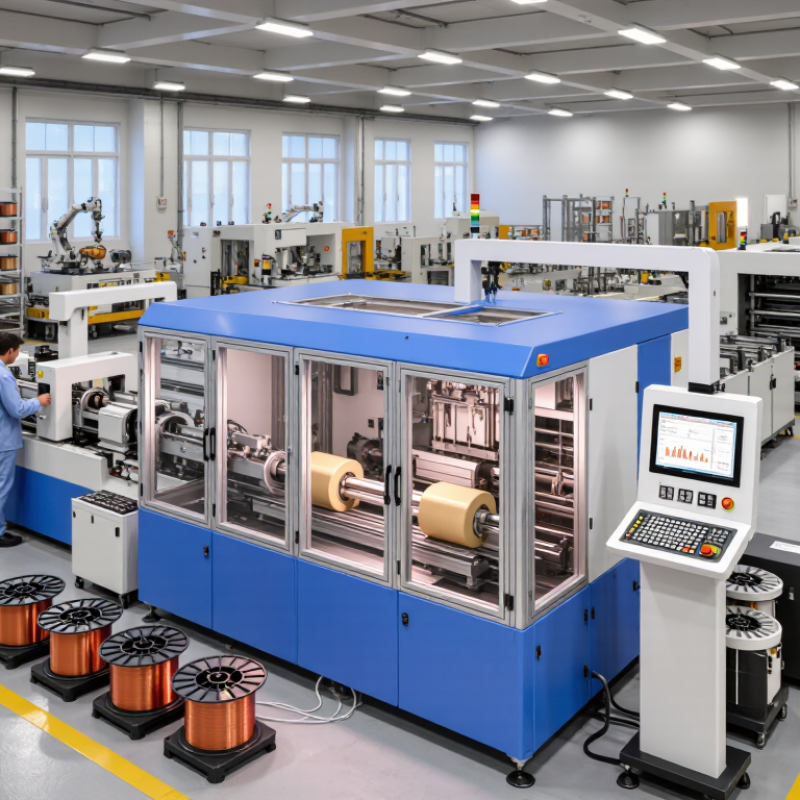
Define Coil Specifications: Wire Size, Turns, Tension, and Winding Pattern
How to Choose a Fully Automatic Coil Winding Machine in 2026?
Define the coil before comparing machines. Record wire diameter, insulation type, target turns, coil length, and acceptable resistance. The wire size controls nozzle selection and tension range. A 0.2 mm wire can react badly to the same tension used for 0.8 mm wire. Too much force stretches the conductor. Too little force creates loose layers.
Turns must be programmed with verified counting accuracy. A small error can change inductance, resistance, and thermal performance.
The IEA Global EV Outlook 2024 reported nearly 14 million electric car sales in 2023. This growth increases demand for repeatable motor and transformer coils. Your machine should store recipes, detect missed turns, and record production data. More automation is useful only when the records are trustworthy.
Winding pattern matters.
Random winding may suit some compact coils, while orthocyclic winding can improve packing density and heat transfer. Ask for samples using your actual wire, bobbin, and insulation. Review tension graphs, wire breaks, crossover quality, and end-position accuracy.
The U.S. Department of Energy reports that motor-driven systems can consume over 70% of industrial electricity in some facilities. Small efficiency losses deserve attention.
Yet specifications are not always perfect. Real wire coatings vary, and operators may load bobbins differently. Allow adjustment ranges instead of choosing a machine by brochure speed alone. Fast is not always stable.
Compare Throughput: Rated Speeds Commonly Range from 1,000 to 6,000 RPM
How to Choose Fully Automatic Coil Winding Machine in 2026?
Rated speed is an important comparison point, but it does not equal finished output. Fully automatic coil winding machines commonly list speeds from 1,000 to 6,000 RPM. A 6,000 RPM rating may look impressive. However, acceleration, wire tension, indexing, cutting, and loading can reduce real production speed.
Use a simple calculation before comparing quotations. If one coil requires 30 turns, a 3,000 RPM spindle offers 100 theoretical coils per minute. At 80% effective utilization, output becomes about 80 coils per minute. This estimate is imperfect, but it exposes unrealistic claims. Ask suppliers for verified cycles per minute using your wire diameter, coil dimensions, and turn count. Request a recorded factory trial, not only a catalog speed.
Energy and repeatability also matter. The International Energy Agency’s Energy Efficiency 2023 report states that electric motor systems consume roughly 53% of global electricity. Efficient acceleration and stable tension can therefore reduce waste during continuous production. Check speed control, vibration, thermal behavior, and rejection rates at both low and high settings. Higher RPM can increase heat and wire breakage. It may also require better balancing and maintenance. The fastest machine is not always the most productive one. Sometimes, 3,000 RPM with 95% uptime beats 6,000 RPM with frequent stoppages.
Check Precision: Review ±0.1% Tension Control and Repeatability Data
When choosing a fully automatic coil winding machine in 2026, inspect tension control before counting production speed. A quoted accuracy of ±0.1% sounds impressive, but it means little without test conditions. Ask for wire diameter, coil size, running speed, and measurement frequency. Also request raw tension curves, not only a certificate.
ISO 5725 separates repeatability from reproducibility. The machine should hold similar tension across repeated coils, operators, and production shifts. A useful factory trial might run 100 coils, then compare starting tension, peak variation, and final coil dimensions. Record the results. Do not rely on one successful sample. Tiny errors accumulate.
This matters beyond appearance. The International Energy Agency’s Energy Efficiency 2023 report estimates that electric motor systems consume about 53% of global electricity. Consistent winding can support efficient motor performance, especially when resistance and magnetic balance are tightly controlled. The U.S. Department of Energy’s 2022 Motor Systems Market Assessment also emphasizes motor-system efficiency across industrial applications.
In practice, ±0.1% should be verified under load. Ask whether calibration includes the tension sensor, dancer arm, and traverse movement. Check the recovery time after acceleration. A machine may pass at steady speed but fail during sudden changes. I would treat unclear repeatability data as a warning. Real production is less tidy than a showroom test.
Verify Safety and Compliance Under ISO 12100 and IEC 60204-1
When choosing a fully automatic coil winding machine in 2026, safety should guide the purchase. ISO 12100 requires a structured risk assessment before safety features are selected. Ask for documented hazards, risk reduction measures, and remaining risks. The assessment should cover rotating shafts, wire breakage, pinch points, noise, heat, and unexpected startup. Walk around the machine during a demonstration. Guards should block access to moving parts. Access doors should stop motion when opened. Emergency stops must be visible and reachable.
IEC 60204-1 focuses on the machine’s electrical equipment and control systems. Inspect the main disconnect, protective bonding, overload protection, and cabinet labeling. Check whether wires are secured and clearly identified. Control voltage should remain stable during normal operation. Test emergency stops, restart prevention, and fault messages. A machine that runs smoothly is not automatically safe. Small details matter.
Request factory acceptance testing with recorded results. Useful evidence includes earth continuity, insulation resistance, emergency-stop response, and guard-interlock tests. Review the wiring diagram, maintenance schedule, operating manual, and operator training materials. During practical audits, I have seen excellent machines fail because workers could bypass a door switch. That risk deserves honest discussion. A checklist alone can mislead. Ask how safety devices are protected from tampering and how changes will be controlled after installation. Suppliers should explain limitations without hiding behind certificates.
How to Choose a Fully Automatic Coil Winding Machine in 2026?
Verify safety and compliance under ISO 12100 and IEC 60204-1 before comparing productivity, automation, and price.
How to use this chart: ISO 12100 defines a three-step risk-reduction order: first use inherently safe design measures, then add safeguarding and complementary protective measures, and finally provide information for use. During equipment selection, request documented evidence for each step and confirm that the machine’s electrical equipment, protective bonding, emergency-stop functions, control systems, and technical documentation are assessed against IEC 60204-1. The numbered values show the required sequence, not a certification score.
Reference framework: ISO 12100:2010 risk-reduction hierarchy and IEC 60204-1:2016 electrical equipment requirements for machinery.
Calculate OEE, Labor Savings, Maintenance Costs, and 3–5-Year ROI
How to Choose a Fully Automatic Coil Winding Machine in 2026?
In 2026, evaluate the machine through measurable factory results, not quoted speed alone. OEE equals availability multiplied by performance and quality. Track real production data for several shifts before buying. For example, an eight-hour shift has 480 minutes. After 50 minutes of stoppages, availability reaches 89.6%. If actual speed reaches 95% of the standard and first-pass quality is 98%, OEE becomes about 83.5%. That number is more useful than a sales brochure.
Calculate labor savings with loaded wages, not basic hourly pay. Include benefits, overtime, training, and supervision. If one machine removes 16 operator-hours daily, the annual saving is 16 multiplied by the loaded wage and operating days. Test this assumption carefully. One operator may still be needed for material loading, inspection, or recovery after faults. A neat spreadsheet can still be wrong. Production records should confirm the staffing change.
Maintenance costs need a five-year view. Estimate preventive service, spare sensors, tooling, lubrication, calibration, software support, and unplanned downtime. Ask for mean time between failures and mean time to repair, using documented service records. Then calculate ROI: cumulative labor savings, added output, and quality savings, minus purchase, integration, training, and maintenance costs. Divide that result by total investment. Compare three-year and five-year outcomes. A faster machine may produce less value if changeovers are difficult or technicians cannot restore it quickly. OEE assumptions should be reviewed quarterly, because factory conditions rarely remain perfect.
FAQS
Record wire diameter, insulation type, target turns, coil length, and acceptable resistance. These details guide nozzle selection and tension settings. Do not compare machines by speed alone.
Thin wire can break when exposed to excessive force.
The machine should provide verified turn counting and detect missed turns. A small counting error can change inductance, resistance, and heat performance. Records should be stored for review. Trust the data, but verify it.
Random winding may suit certain compact coils. Orthocyclic winding can improve packing density and heat transfer. The best choice depends on the actual wire, bobbin, and insulation. Samples reveal more than a brochure.
Use your actual wire, bobbin, and insulation during testing. Review tension graphs, wire breaks, crossover quality, and end-position accuracy. Watch how operators load bobbins. Real production can differ.
Guards should block access to rotating shafts and other moving parts. Opening an access door should stop motion immediately. Emergency stops must be visible and reachable. Restart prevention matters too. Small details matter.
Inspect the main disconnect, protective bonding, overload protection, and cabinet labels. Check that wires are secured and clearly identified. Test emergency-stop response, fault messages, and restart prevention. A smooth-running machine is not automatically safe.
Request recorded tests for earth continuity, insulation resistance, guard interlocks, and emergency stops. Review wiring diagrams, maintenance schedules, operating manuals, and training materials. Ask how safety devices resist tampering. Certificates alone may not explain practical risks.
Conclusion
Choosing a Fully Automatic Coil Winding Machine in 2026 requires a clear understanding of your production requirements and long-term operating goals. Begin by defining the coil specifications, including wire size, number of turns, winding tension, and required winding pattern. These details determine the machine’s compatibility, configuration, and overall product quality. Next, compare throughput carefully, as rated speeds commonly range from 1,000 to 6,000 RPM. However, speed should always be evaluated alongside stability, changeover time, and actual production efficiency.
Precision is equally important. Review tension-control performance, such as ±0.1% accuracy, as well as repeatability data under continuous operation. The machine should also support a safe working environment and comply with relevant requirements such as ISO 12100 and IEC 60204-1. Finally, assess the total investment by calculating OEE, labor savings, maintenance expenses, energy consumption, and expected return on investment over three to five years. A balanced evaluation will help you select reliable equipment that improves productivity while controlling costs.